Holter monitor in Kingston upon Thames: 24 hours to 14 days
A Holter monitor records every heartbeat while you carry on with your normal life. At KONCEPT® Medical Clinic in Kingston a 24 hour Holter costs £295, 72 hours £425, up to 7 days £595 and a 14 day patch monitor £750, each reported by our cardiologist, Dr Ameer Al-Bassam.
FittingAbout 15 minutes
You wear it24 hours, 72 hours, up to 7 days or up to 14 days
Chest pain now? Do not book a test. If you have chest pain or pressure that lasts more than a few minutes, pain spreading to your arm, jaw or back, sudden severe breathlessness, or you have fainted, call 999 straight away.
Verified statistics
Holter monitoring by the numbers
Drawn from British Heart Foundation figures, NICE clinical guidelines and peer-reviewed research. Every figure links to its citation in the References section at the bottom of this page.
Why a longer heart recording helps
43%
of people seen with palpitations had a heart cause found
A Holter monitor is a small, portable ECG recorder that you wear for 24 hours to 7 days. A few sticky patches on your chest connect to the recorder, which records every heartbeat through the day and while you sleep. For recordings longer than 7 days we use a single adhesive patch monitor, worn on the chest for up to 14 days.
It is the test for symptoms that come and go, because a standard ECG records only a few seconds. You keep a short diary of your symptoms, so the cardiologist can match what you felt with what your heart was doing at that moment.
Choosing the length
How long should you wear a Holter monitor?
The right length depends on how often your symptoms happen. The more often they happen, the shorter the recording can be. Your cardiologist will advise you, but as a guide:
Your symptoms happen
Usual recording
Price
Every day
24 hours
£295
Every few days
Up to 72 hours
£425
About once a week
Up to 7 days
£595
Less than once a week
Up to 14 days, patch monitor
£750
Who it is for
Why might you need a Holter monitor?
You might need a Holter monitor if you have palpitations, missed or extra beats, dizzy spells or blackouts that come and go, or if your ECG was normal but your symptoms continue.
Palpitations
A racing, fluttering or pounding heartbeat that comes and goes, or a feeling of skipped beats.
Dizzy spells or blackouts
Light headedness or fainting, to see whether a slow or fast heart rhythm is the cause.
A normal ECG, but symptoms continue
A longer recording catches episodes that a 10 minute ECG can miss.
Checking a known rhythm problem
Such as atrial fibrillation, or checking how well rhythm or rate medicines are working.
Three examples of when a Holter helps
Illustrative examples, not real patients.
Fluttering a few times a week
Symptoms every few days
A woman in her forties notices a flutter in her chest two or three times a week, usually in the evening. Her 12 lead ECG is normal. A 72 hour Holter catches several of the episodes, each of which is a run of harmless extra beats. She is reassured and no treatment is needed.
What the Holter caught: a run of extra beats
72 hour HolterReassured, no treatment
Dizzy spells once a day
Symptoms every day
A man in his seventies feels light headed most days and has blacked out once. A 24 hour Holter shows his heart pausing for several seconds overnight and during one of the dizzy spells. He is referred the same week for a pacemaker assessment.
What the Holter caught: a pause in the rhythm
24 hour HolterPacemaker assessment
An irregular pulse on a smartwatch
Symptoms about weekly
A man in his fifties gets an irregular rhythm alert from his watch about once a week. A 7 day Holter records two episodes of atrial fibrillation lasting a few hours each. He starts treatment to lower his stroke risk and his NHS GP takes over long term care.
What the Holter caught: atrial fibrillation
7 day HolterStroke risk lowered
What these have in common. In each case the symptom came and went, so a 10 minute ECG in clinic could not catch it. The right Holter length was chosen from how often the symptom happened, which is the table above.
Your appointment
What happens when you wear a Holter monitor?
Your Holter monitor is fitted at KONCEPT® on Wood Street in Kingston, and you then go about your normal days.
If palpitations are the reason for your Holter, a thyroid test can be booked at the same visit.
Fitting takes about 15 minutes at KONCEPT®. You then go home and carry on as normal, and bring the monitor back at the end of the recording.
Before. Have a shower before your appointment, as you cannot bath or shower while wearing the 24 hour to 7 day monitor. If you are fitted with the 14 day patch, we will tell you at fitting whether you can shower with it. Wear loose, comfortable clothing and do not put body lotion on your chest.
Fitting. Our nurse places a few sticky patches on your chest and connects the small recorder, which you wear on a belt, in a pocket or clipped to your clothes. We give you a symptom diary and show you how to use it.
While you wear it. Go about your normal day, including work, walking and sleep. Keep the monitor dry. Whenever you feel a symptom, write down the time and what you felt.
Returning it. Bring the monitor back to KONCEPT® at the end of the recording. The recording is then analysed and reported.
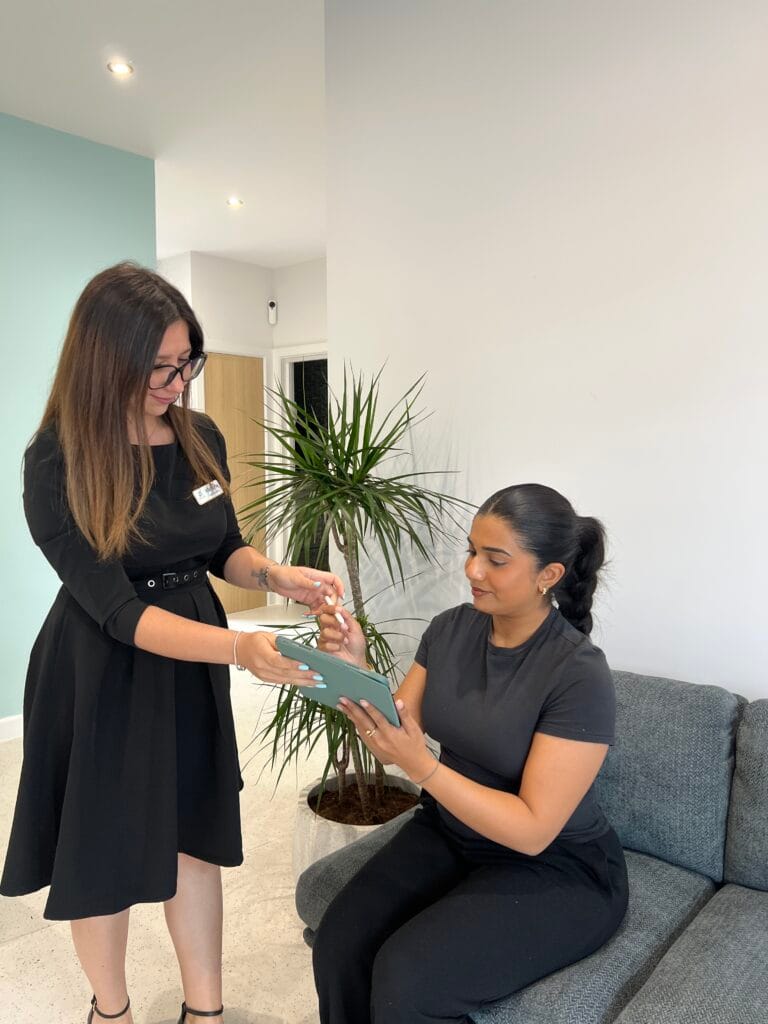
Our team at KONCEPT®, Wood Street, Kingston.
Results
Your Holter results and report
Once the recording has been analysed, Dr Ameer Al-Bassam reviews it and you receive a written report. It covers your heart rate through the day and night, any pauses, extra beats or abnormal rhythms such as atrial fibrillation, and what your heart was doing when you wrote down a symptom. With your consent, we send a copy to your NHS GP.
If something on the recording needs attention sooner, we contact you straight away.
What the recording shows
What can a Holter recording reveal?
A Holter recording is a continuous ECG, so the cardiologist can see every beat over the whole recording and match any change to the time you wrote in your diary. These are examples of the three findings patients most often ask about. They are illustrations, not real patient recordings.
Normal rhythm. Evenly spaced beats with the same shape each time. Most Holter recordings look like this for most of the day, which is reassuring in itself.An extra beat (ectopic). One early, wider beat, then a short pause before the rhythm settles. This is the usual cause of a thump, flutter or skipped beat, and in a healthy heart it is almost always harmless.A pause. The rhythm stops for a few seconds and then restarts. A pause of this kind, especially when it lines up with a dizzy spell or blackout in your diary, is one of the findings a Holter is designed to catch.
A Holter can also show a heart rate that is too slow or too fast for what you were doing, runs of fast rhythm such as supraventricular tachycardia, and atrial fibrillation that comes and goes. Dr Al-Bassam explains any finding in plain words in your written report.
Choosing a test
Holter, ECG or echo: which heart test do you need?
A Holter monitor is for symptoms that come and go. A 12 lead ECG is a quick first check, 24 hour blood pressure monitoring checks your blood pressure, and an echocardiogram looks at the structure of your heart. If you are not sure which you need, start with a cardiology consultation.
A specialist assessment that decides which tests you need
Often used for any heart symptom or concern
Prices
How much does a Holter monitor cost in Kingston?
At KONCEPT® in Kingston a 24 hour Holter monitor costs £295, a 72 hour heart monitor £425 and a heart monitor for up to 7 days £595 and a 14 day patch monitor £750. Each price includes the fitting, the analysis, a report from our cardiologist and a fixed price confirmed in writing.
24 hour Holter monitor, reported by our cardiologist£295
72 hour heart monitor, reported by our cardiologist£425
Heart monitor up to 7 days, reported by our cardiologist£595
14 day patch heart monitor, reported by our cardiologist£750
A £50 reservation fee is paid when you book and is taken off your final bill, so the price you see is the total you pay. It is refunded in full if you cancel 24 hours or more before your appointment.
Can I use my health insurance for a Holter monitor?
Many private medical insurance policies cover a Holter monitor when it is needed to investigate symptoms, if your policy includes outpatient cover. For your insurer to pay, the clinic and the cardiologist usually both need to be recognised by that insurer, and most insurers ask for a GP or open referral and a pre authorisation number first.
Dr Ameer Al-Bassam is recognised by Aviva, Vitality and WPA. His recognition by BUPA is being arranged.
KONCEPT® is recognised by BUPA for most of our blood tests and diagnostic tests.
Please call 020 8129 1011 with your insurer and policy number before you book, so we can confirm your cover in writing. If you pay for yourself, no GP referral is needed.
Your cardiologist
Who reports your Holter recording?
Every Holter recording made at KONCEPT® is reported by Dr Ameer Al-Bassam, a specialist and interventional cardiologist on the GMC Specialist Register for cardiology, who also works in the NHS at Chelsea and Westminster Hospital NHS Foundation Trust.
No. The monitor must stay dry, so have a shower before your appointment and wait until it is removed before you bath, shower or swim.
Can I sleep with a Holter monitor on?
Yes, and you should. The night time recording is part of the test. Most people sleep normally with the small recorder beside them or clipped to their nightwear.
Is a Holter monitor the same as a 24 hour ECG?
Yes. A 24 hour Holter monitor is a 24 hour ECG. At KONCEPT® the same type of monitor can also record for up to 72 hours or up to 7 days. For longer recordings we use a patch monitor worn for up to 14 days.
What if I have no symptoms while I wear it?
The recording is still useful, as it shows your heart rate and rhythm through the day and night. If your symptoms are less frequent, the cardiologist may suggest a longer recording.
Do I need a GP referral for a Holter monitor?
No, not if you are paying for yourself. If you are using health insurance, your insurer will usually ask for a referral and a pre authorisation number first.
How much does a Holter monitor cost in Kingston?
At KONCEPT® a 24 hour Holter monitor costs £295, 72 hours £425, up to 7 days £595 and a 14 day patch monitor £750, each with a report from our cardiologist.
Can I exercise while wearing a Holter monitor?
Yes. Carry on with your usual activities, including exercise, as long as the monitor stays dry. Heavy sweating can loosen the stickers, so note in your diary if one comes off.
What if a sticker comes off?
Press it back on firmly if you can and note the time in your diary. If it will not stay on, call us on 020 8129 1011.
What does a Holter monitor show?
Your heart rate through the day and night, any pauses, extra beats and abnormal rhythms such as atrial fibrillation, and what your heart was doing at the moments you wrote down a symptom.
KONCEPT® Medical Clinic is registered with the Care Quality Commission (CQC). Medical Director Dr Maryam Attarzadeh (GMC 7193218). Page medically reviewed by Dr Maryam Attarzadeh and cardiologist Dr Ameer Al-Bassam (GMC 7471608), 7 November 2026.
Book a Holter monitor in Kingston
46 to 48 Wood Street, Kingston upon Thames, KT1 1UW · 020 8129 1011 · info@konceptmedicalclinic.com
Statistics and clinical information on this page are drawn from British Heart Foundation figures, NHS health information, NICE clinical guidelines and peer-reviewed research. Each source is linked for verification.
1Peer-reviewed cohort study
Weber BE, Kapoor WN.
Evaluation and outcomes of patients with palpitations.
American Journal of Medicine 1996, 100(2), 138-148
Statistics and references reviewed by: Dr Maryam Attarzadeh, Founder and Medical Director (GMC 7193218), 8 November 2026. Next review due: 8 May 2027. Statistical claims are re-verified every 6 months, or sooner if peer-reviewed evidence changes.