12 lead ECG
Your heart rhythm and electrical activity at rest, in about 10 minutes
Often used for palpitations, chest pain, dizziness, checks before treatment

A 12 lead ECG at KONCEPT® Medical Clinic in Kingston costs £119, takes about 10 minutes and includes a report from our cardiologist, Dr Ameer Al-Bassam. No GP referral is needed if you pay for yourself.
Drawn from British Heart Foundation figures and NICE clinical guidelines. Every figure links to its citation in the References section at the bottom of this page.
Why an ECG mattersAn ECG (electrocardiogram) is a quick, painless recording of the electrical signals that make your heart beat. Ten small sticky patches on your chest, arms and legs pick up those signals, and the machine turns them into 12 views of your heart, which is why it is called a 12 lead ECG.
It shows your heart rate and rhythm, and it can show signs of strain on the heart muscle, a problem with the heart’s wiring, or a heart attack in the past. Because it records only a few seconds, symptoms that come and go may need a longer recording with a Holter monitor.
You might need an ECG if you have palpitations, chest pain, dizziness or breathlessness, or if a doctor wants a baseline check of your heart before treatment, sport or a work medical.
A racing, pounding, fluttering or irregular heartbeat, or a feeling of missed beats.
Chest pain or tightness that comes and goes and is not happening now. If you have chest pain now, call 999 instead.
Dizzy spells, light headedness, fainting in the past, or getting out of breath more easily than before.
Some medicines, sport, travel and work medicals need a baseline ECG, and so do people with high blood pressure or diabetes.
An ECG at KONCEPT® takes about 10 minutes from start to finish. You lie on a couch, the patches are placed, and the recording itself takes a few minutes while you lie still.
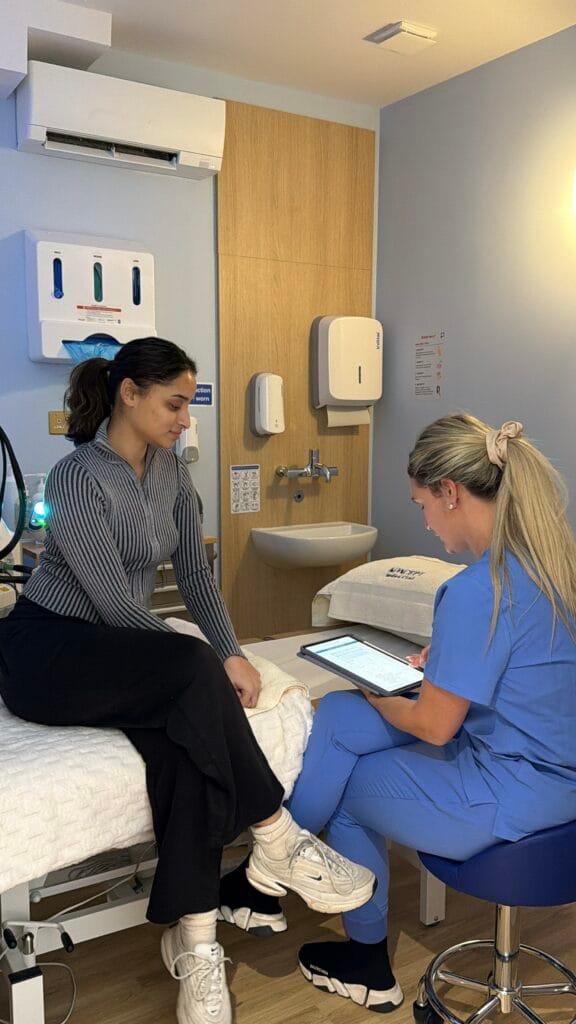
Your ECG is reported by our cardiologist, Dr Ameer Al-Bassam, and you receive a written report, usually within a few working days. If anything on your ECG needs attention sooner, we contact you without waiting for the written report. With your consent, we send a copy to your NHS GP.
A normal ECG is reassuring, but it shows only the moment it was recorded. If your symptoms come and go, a Holter monitor records every heartbeat for longer, and if the cardiologist needs to see the structure of your heart and its valves, an echocardiogram is the test that shows it.
An ECG is the first test for most heart symptoms. A Holter monitor records your rhythm for longer, 24 hour blood pressure monitoring checks your blood pressure through a normal day, and an echocardiogram looks at the heart itself. If you are not sure which you need, start with a cardiology consultation.
Your heart rhythm and electrical activity at rest, in about 10 minutes
Often used for palpitations, chest pain, dizziness, checks before treatment
Every heartbeat through your normal days and nights
Often used for palpitations, dizzy spells or blackouts that come and go
Your blood pressure through a normal day and night
Often used for confirming or ruling out high blood pressure, checking treatment
The structure, pumping and valves of your heart
Often used for breathlessness, a heart murmur, swollen ankles, an abnormal ECG
A specialist assessment that decides which tests you need
Often used for any heart symptom or concern
A private 12 lead ECG at KONCEPT® in Kingston costs £119. The price includes the test, a report from our cardiologist and a fixed price confirmed in writing before you book, with no separate reporting fee.
A £50 reservation fee is paid when you book and is taken off your final bill, so the price you see is the total you pay. It is refunded in full if you cancel 24 hours or more before your appointment.
If you see the cardiologist, an ECG can usually be done at the same visit. See all cardiology prices.
Many private medical insurance policies cover an ECG when it is needed to investigate symptoms, if your policy includes outpatient cover. For your insurer to pay, the clinic and the cardiologist usually both need to be recognised by that insurer, and most insurers ask for a GP or open referral and a pre authorisation number first.
Please call 020 8129 1011 with your insurer and policy number before you book, so we can confirm your cover in writing. If you pay for yourself, no GP referral is needed.
Every ECG recorded at KONCEPT® is reported by Dr Ameer Al-Bassam, a specialist and interventional cardiologist on the GMC Specialist Register for cardiology, who also works in the NHS at Chelsea and Westminster Hospital NHS Foundation Trust.

Dr Ameer Al-Bassam
Specialist and interventional cardiologist · Chelsea and Westminster NHS. Clinic dates: call 020 8129 1011.
Read full bio →No, not if you are paying for yourself. You can book a private ECG at KONCEPT® directly. If you are using health insurance, your insurer will usually ask for a referral and a pre authorisation number first.
About 10 minutes in clinic. The recording itself takes only a few minutes while you lie still.
No. An ECG only records the electrical signals from your heart through sticky patches on your skin. Nothing passes into your body. Peeling the patches off can feel like removing a plaster.
Yes. There is no need to fast before a resting ECG. Avoid body lotion, oil or talc on your chest on the day, as the patches need clean, dry skin.
You receive a written report from our cardiologist, usually within a few working days. If anything needs attention sooner, we contact you without waiting for the written report.
Yes. An ECG shows your heart’s electrical activity only while it is being recorded, so a rhythm problem that comes and goes, or a problem with a heart valve, can be missed. That is why the cardiologist may suggest a Holter monitor or an echocardiogram as well.
A private 12 lead ECG at KONCEPT® in Kingston costs £119, including the report from our cardiologist.
A borderline result means a small change that is not clearly normal or abnormal, and it is common in healthy people. Our cardiologist looks at it alongside your symptoms and history, and tells you whether anything else is needed, such as a repeat ECG or an echocardiogram.
Yes. NICE guidance recommends a 12 lead ECG for people diagnosed with high blood pressure, to check whether it has affected the heart.[6]
Often, yes. An ECG can show changes left by a previous heart attack, although a normal ECG does not rule one out.
A 12 lead ECG records your heart for a few seconds while you lie still in the clinic. A Holter monitor records every heartbeat for 24 hours to 14 days while you go about your life, so it can catch symptoms that come and go.
KONCEPT® Medical Clinic is registered with the Care Quality Commission (CQC). Medical Director Dr Maryam Attarzadeh (GMC 7193218). Page medically reviewed by Dr Maryam Attarzadeh and cardiologist Dr Ameer Al-Bassam (GMC 7471608), 7 November 2026.
46 to 48 Wood Street, Kingston upon Thames, KT1 1UW · 020 8129 1011 · info@konceptmedicalclinic.com
Statistics and clinical information on this page are drawn from British Heart Foundation figures, NHS health information and NICE clinical guidelines. Each source is linked for verification.
Number of UK people with heart rhythm condition rises by 50% in a decade.
BHF news, 19 May 2023
bhf.org.uk/what-we-do/news-from-the-bhf/news-archive/2023/may/new-figures-show-the-number-of-uk-people-with-heart-rhythm-conditionTransient loss of consciousness (‘blackouts’) in over 16s (CG109).
NICE, August 2010, updated November 2023
nice.org.uk/guidance/cg109Atrial fibrillation: diagnosis and management (NG196).
NICE, April 2021, updated June 2021
nice.org.uk/guidance/ng196Electrocardiogram (ECG).
NHS website, page last reviewed 9 November 2023
nhs.uk/tests-and-treatments/electrocardiogramPalpitations.
NICE CKS, last revised February 2026
cks.nice.org.uk/topics/palpitationsHypertension in adults: diagnosis and management (NG136).
NICE, August 2019, updated February 2026
nice.org.uk/guidance/ng136Statistics and references reviewed by: Dr Maryam Attarzadeh, Founder and Medical Director (GMC 7193218), 8 November 2026. Next review due: 8 May 2027. Statistical claims are re-verified every 6 months, or sooner if peer-reviewed evidence changes.