What does a PCOS laser treatment plan involve? At KONCEPT® Medical Clinic, laser for PCOS-related hair follows six stages: a free doctor-led consultation, an optional PCOS blood test, a test patch, a course of at least 8 laser sessions spaced 4 to 8 weeks apart, a year of maintenance, and then discharge. The plan is designed to take about two years from your first visit.
This guide walks you through each stage of the journey, step by step. For treatment details, prices and booking, see our main page on laser hair removal for PCOS and hirsutism.
Key facts
- PCOS is being renamed PMOS (polyendocrine metabolic ovarian syndrome). It is the same condition.
- Laser manages the hair. It does not treat PCOS itself, so the cause is worth assessing alongside.
- A blood test is optional but recommended before you start.
- Hormone-driven hair needs a minimum course of 8 sessions, 4 to 8 weeks apart.
- Every session is carried out by a GMC-registered doctor using a medical laser (not IPL). Results vary with your skin type and hair colour.
- A maintenance year follows your course, before you are discharged.
Your journey at a glance
PCOS is now PMOS: what the name change means
Polycystic ovary syndrome (PCOS) has been renamed polyendocrine metabolic ovarian syndrome (PMOS). The new name was agreed in a global consensus published in The Lancet in May 2026. It is the same condition, and nothing changes about your diagnosis or treatment.
The new name reflects that the condition affects hormones and metabolism, not only the ovaries, and that polycystic ovaries are not needed for a diagnosis. The change is being introduced over three years, with the 2028 international guideline update, so you will still see PCOS on most forms, results and NHS letters for now. This guide uses PCOS, the name most patients still know, and PMOS where it helps.
Step 1: your free doctor-led consultation
Your plan starts with a free consultation with a GMC-registered doctor, who also performs your treatment. The doctor asks when the hair started, how quickly it is changing, and about your periods, acne, scalp hair, weight and any medicines you take, including hormonal contraception and acne treatments. The doctor then looks at the hair in each area you want treated and confirms your Fitzpatrick skin type.
You do not need a PCOS diagnosis to book. Excess hair on the chin, upper lip, jawline, neck, chest or stomach can be assessed whether or not a hormonal cause has been looked for.
Laser works on hair that still has pigment, so it is less effective on blond, grey or white hair. UK guidance notes that laser works best on darker hair and lighter skin, can be uncomfortable and needs several sessions. Your doctor will tell you honestly how well it is likely to work for you, and talk through other options if laser is not a good fit.
Step 2: the PCOS blood test (optional, recommended)
Laser can start without a blood test, but we recommend one. Knowing your hormone picture helps your doctor set a realistic plan and decide whether you would benefit from a medical review of the cause.
The KONCEPT® PCOS blood test covers 14 markers in six groups: reproductive hormones, androgens (including SHBG and the free androgen index), AMH, thyroid, adrenal (17-OHP) and metabolic markers (fasting glucose, fasting insulin and HOMA-IR). It is one all-inclusive price of £338, including a review by a GMC-registered doctor. Most results are ready within 2 to 5 working days.
Where possible, the test is booked in the morning and early in your cycle (day 2 to 5), so the hormones can be interpreted. If your periods are irregular or absent, the doctor advises the best timing. If you use hormonal contraception, tell your doctor before booking, because UK guidance notes it affects the hormone results. Do not stop any contraception without medical advice. If you already have recent results from your GP, bring them to your consultation.
How PCOS is diagnosed
UK guidance (NICE Clinical Knowledge Summaries) diagnoses PCOS in adults when two of these three are present, once other causes have been ruled out: irregular or absent ovulation, signs of raised male-type hormones such as excess hair or raised testosterone in the blood, and polycystic ovaries on an ultrasound scan. The guidance notes that excess hair on its own is a strong pointer to raised male-type hormones and PCOS in adults. Only a doctor can confirm a diagnosis, using your results together with your symptoms and history.
When your doctor refers you on
UK guidance advises urgent referral to a hormone specialist (endocrinology), within two weeks, if there could be a rare hormone-producing growth. Signs include hair that appears suddenly or worsens quickly, a deepening voice or increased muscle bulk, or a markedly raised testosterone level. Other abnormal results lead to a routine referral. If this applies to you, your doctor arranges the referral through your GP. In most cases laser can continue alongside, and your doctor will tell you if it should wait.
Step 3: your test patch
Before your first session, a small test patch is carried out at least 48 hours ahead, so any reaction has time to show. It is checked at 48 hours. For darker skin it is also checked at two weeks, before your first full session, for any lightening or darkening of the skin. The £50 patch test fee is redeemable against your first treatment.
Step 4: your course of at least 8 sessions
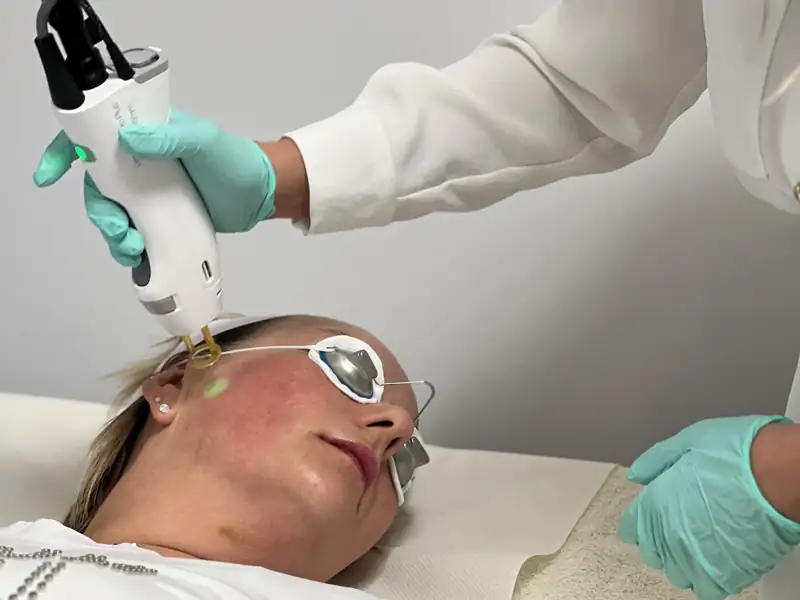
Hair grows in cycles, and each session only treats the follicles that are actively growing that day. The international PCOS guideline notes that women with PCOS may need more laser sessions than women whose excess hair has no hormonal cause. That is why we plan hormone-driven hair as a minimum course of 8 sessions, spaced 4 to 8 weeks apart.
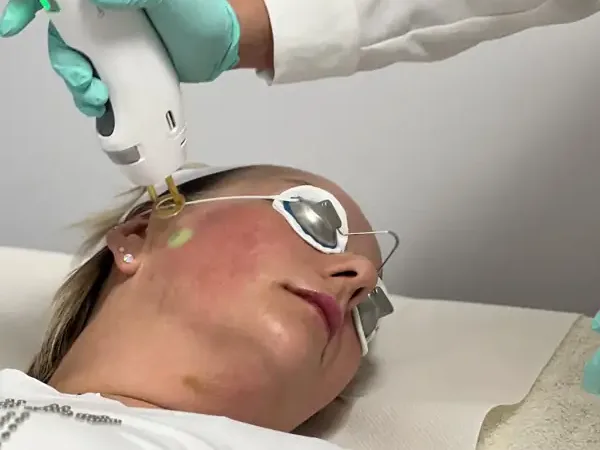
We use the Candela GentleMax Pro Plus, a medical laser (not IPL) that combines Alexandrite 755 nm and Nd:YAG 1064 nm wavelengths, so the doctor can match the wavelength and settings to your skin and hair. The sensation is often described as a quick warm flick, and built-in skin cooling helps, though some areas can feel uncomfortable. Between sessions, shave only. Do not wax, pluck, thread or epilate, because the laser needs the hair root in place.
The aim is a lasting reduction in hair, not total removal, and results vary from person to person. If some hair appears between sessions, that can be the hormones at work and does not mean the laser has failed. Your doctor reviews your progress at each session.
Side effects are usually mild, such as redness or small bumps that settle within hours to a day. Less often the skin can lighten or darken for a while, particularly in darker or recently tanned skin. In a small number of people, laser can stimulate finer hair instead of reducing it (paradoxical hypertrichosis). Your doctor explains these risks and takes your consent before treatment. See our preparation and aftercare guide and, for darker skin, our guide to laser hair removal for dark skin.
Medical treatment alongside laser
Laser treats the hair, not the hormones. There are also medical treatments for PCOS-related hair, and whether any of them is right for you can only be decided at a consultation with a doctor. You can discuss this with your own GP or book a KONCEPT® GP consultation (30 minutes, £149). A review of the evidence suggests medical treatment alongside laser may offer additional benefit.
Step 5: your maintenance year
Because the hormonal drive carries on, new hair can appear after your course. Occasional top-up sessions keep it under control. How many you need varies from person to person. This is a normal part of managing PCOS hair.
We do not repeat your blood test routinely during laser. If your symptoms change, for example hair growth suddenly speeds up, tell your doctor and the test can be repeated. Longer-term PCOS health checks, such as blood pressure and blood sugar, stay part of your wider care with your GP.
Step 6: discharge
Once your hair growth has been stable over a year of maintenance, you are discharged from your laser plan. You can come back at any time if new growth appears, for example after a change in medication, pregnancy or the menopause.
Your plan at a glance
| Stage | When | What happens |
|---|---|---|
| Consultation | Week 0 | Free doctor-led assessment of your skin, hair and history |
| PCOS blood test | Morning, day 2 to 5 of your cycle | Optional, recommended. 14 markers, results in 2 to 5 working days |
| Test patch | At least 48 hours before session 1 | Checked at 48 hours, and at two weeks for darker skin |
| Laser course | About 7 to 14 months | At least 8 sessions, 4 to 8 weeks apart |
| Maintenance | 12 months after your course | Top-up sessions as new growth appears |
| Discharge | About two years from your first visit | When growth is stable. Return any time if hair regrows |
Who this plan is for
Laser hair removal at KONCEPT® is for adults aged 18 and over. We do not treat during pregnancy or breastfeeding, and treatment is deferred if you are taking isotretinoin or have recently stopped it. Your consultation and test patch confirm whether laser is right for you, and you will have time to consider your plan and its risks before treatment starts.
Start your plan with a free consultation
Talk to a doctor about your hair, your skin and the right plan for you at KONCEPT® Medical Clinic, 46 to 48 Wood Street, Kingston upon Thames, KT1 1UW. Prices for every area are on our laser hair removal price list.
Frequently asked questions
Do I need a PCOS diagnosis before laser hair removal?
No. You can book a free consultation without a diagnosis. Your doctor assesses your hair and history and can recommend a PCOS blood test to look for a hormonal cause.
Do I need a blood test before starting laser for PCOS?
It is not required, but we recommend it. The KONCEPT® PCOS blood test covers 14 markers and helps your doctor set a realistic plan. Recent results from your GP can be used instead.
Can I have the PCOS blood test if I use hormonal contraception?
Tell your doctor before booking. UK guidance notes that hormonal contraception affects the hormone results, so your doctor will advise whether and when to test. Do not stop any contraception without medical advice.
How long does the whole PCOS laser plan take?
The plan is designed to take about two years: a course of at least 8 sessions over roughly 7 to 14 months, then a year of maintenance before discharge. It can take longer if you need more sessions.
When am I discharged from my laser plan?
Once your hair growth has been stable over a year of maintenance. You can return at any time if new growth appears, for example after a change in medication, pregnancy or the menopause.
What is PMOS?
PMOS, polyendocrine metabolic ovarian syndrome, is the new name for polycystic ovary syndrome (PCOS), agreed in a global consensus published in The Lancet in May 2026. It is the same condition. The name is being introduced over three years, so PCOS is still widely used.
References:
- NICE Clinical Knowledge Summaries: Polycystic ovary syndrome (last revised March 2025), and Hirsutism (last revised October 2024).
- Teede HJ and others. Recommendations from the 2023 International Evidence-based Guideline for the Assessment and Management of Polycystic Ovary Syndrome. Monash University, 2023.
- Global consensus on renaming polycystic ovary syndrome as polyendocrine metabolic ovarian syndrome (PMOS). The Lancet, May 2026.
- Royal College of Obstetricians and Gynaecologists. Long-term consequences of polycystic ovary syndrome, Green-top Guideline No. 33.
- Candela. GentleMax Pro Plus device information.
Medically reviewed by Dr Maryam Attarzadeh, GMC 7193218, Medical Director at KONCEPT® Medical Clinic. Last reviewed 21 October 2026. Next review April 2027.
This article is general information and does not replace advice at your consultation. Suitability for laser hair removal is confirmed at a consultation. KONCEPT® Medical Clinic is registered with the Care Quality Commission and is located at 46 to 48 Wood Street, Kingston upon Thames, KT1 1UW.