Spider veins, broken veins.
National Health Service
nhs.uk/conditions/varicose-veins
Service
Medically-led
Device
GentleMax Pro Plus
Typical course
2 to 4 sessions
Face sclerotherapy
Not used
Drawn from NHS, the British Association of Dermatologists, NICE Clinical Knowledge Summaries, peer-reviewed publications by Goldberg, Anderson & Parrish (the founding selective-photothermolysis paper), and European Society for Laser Dermatology vascular-laser guidelines. Every figure links to its citation in the References section at the bottom of this page.
How common facial thread veins areVery common
facial thread veins / broken capillaries from the 30s onwards, more in fair-skinned people
60-80%
typical improvement per session in published literature, individual results vary
Goldberg DJ[6]
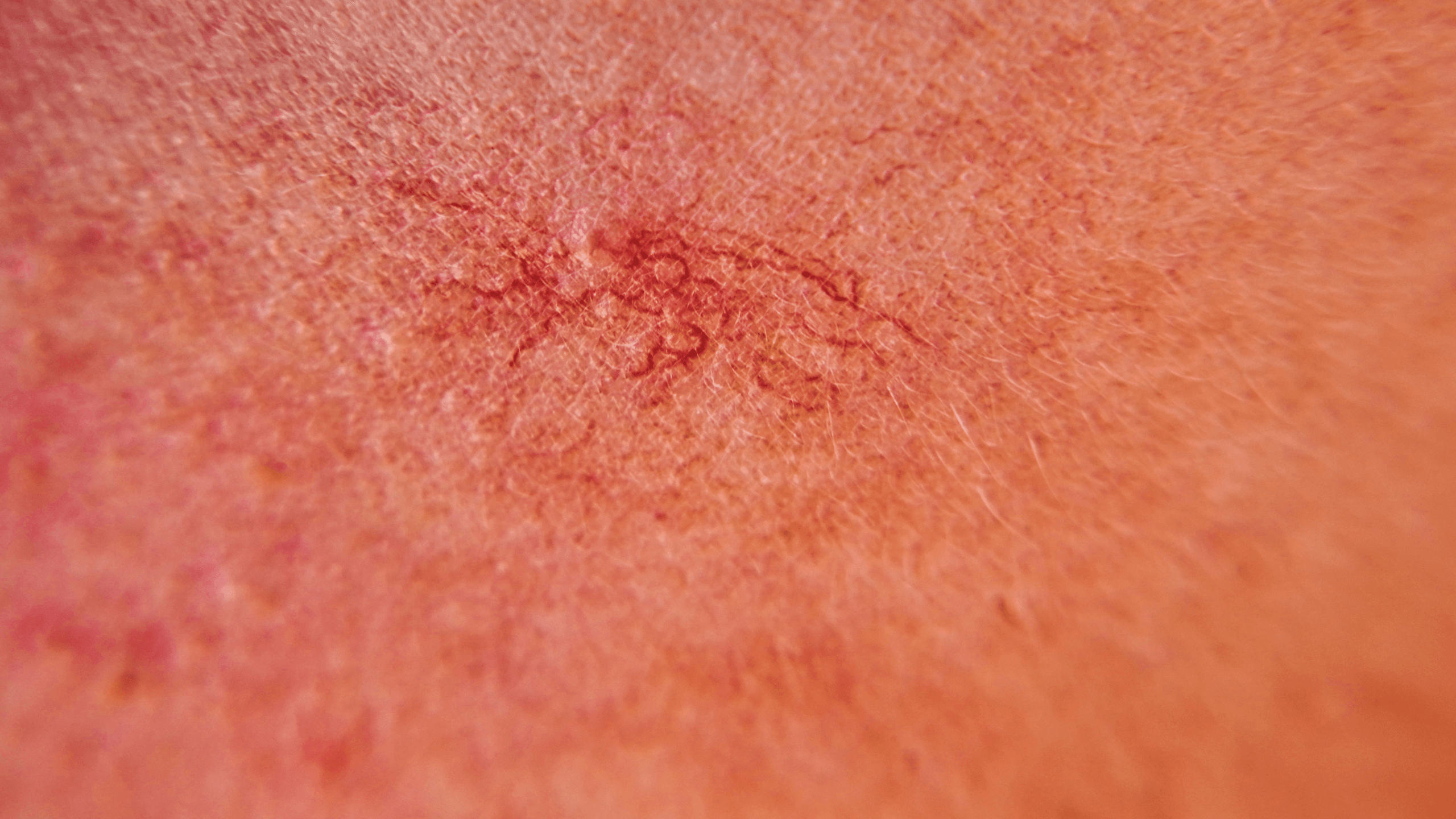
Facial thread veins are small dilated blood vessels just under the surface of the facial skin, typically 0.1 to 1 mm wide. They are also called broken capillaries, broken veins, spider veins on the face, facial spider veins or facial telangiectasia[1][4].
They appear most often around the nose (alar groove), on the cheeks (malar area), the chin and sometimes the forehead. They are usually painless, but can be cosmetically bothersome and tend to become more visible with age.
Facial thread veins are not the same as varicose veins (which are larger, raised, on the legs) and are usually not the same as the leg thread veins that respond to microsclerotherapy. Facial skin and facial circulation are too delicate to inject sclerosant safely, this is why the standard treatment for facial vessels is laser or IPL[4][6][7].
Recognised contributing factors include[1][4][5]:
If your facial thread veins sit alongside persistent flushing, facial redness, papules or eye involvement, rosacea may be the underlying driver and a dermatology assessment is worth considering before or alongside the cosmetic vein treatment.
When to treatTreatment is usually for cosmetic reasons. We see patients in three broad situations:
Cosmetic facial vessel treatment works best when the diagnosis is clear and expectations are explicit[4][8]:
A consultation with our laser clinician, with consultant vascular oversight, in a CQC-registered clinic.
Detailed history, including how long the vessels have been there, prior treatment, skin type (Fitzpatrick), sun exposure habits, any rosacea or other skin condition, current skin-care, recent sun exposure or tanning, current medications including topical steroids.
Examination and photography of the affected area (with your consent), to map the vessels and track response.
Skin assessment for Fitzpatrick type, recent tan and any contraindications to laser / IPL.
Assessment for rosacea as a driver, with referral or coordination with our Dermatology service where indicated.
A written plan, including which device setting is most appropriate, expected number of sessions, expected outcome, after-care and the cost.
A collaborative approach. Facial thread veins, broken capillaries and spider veins are assessed and treated together across our dermatology, laser and vascular teams, with the right approach chosen for you at your consultation rather than fixed to one department.
Initial consultation pricing is on the pricing page.
Treatment optionsA pulsed laser delivers light energy at a wavelength absorbed by haemoglobin in the target vessel. The vessel heats, the wall is damaged, and over the following weeks the body reabsorbs it. This principle is called selective photothermolysis and underpins all medical vascular lasers[7].
KONCEPT® uses the Candela GentleMax Pro Plus, a long-pulsed Nd:YAG and Alexandrite platform that is well-suited to vascular targets across a range of skin types[6][8].
IPL uses a broader spectrum of light filtered to target vascular and pigment chromophores. It is useful where facial thread veins sit alongside diffuse rosacea-related redness, because IPL can treat both at once. IPL is less suited to dark or recently-tanned skin, and the choice between laser and IPL is made at the consultation[6][8].
Sclerotherapy is the gold standard for leg thread veins, but it is not used on the face. The facial circulation has direct connections to deeper vessels around the eyes and brain, and injection of sclerosant in this area carries a small but real risk of serious complications. Laser and IPL are the safer and effective alternatives for facial vessels[6][7].
If your interest is leg thread veins, that pathway is different. See Leg thread vein treatment.
We want you to make an informed choice. Here is what the published evidence and our own practice tell patients to expect.
If you are unsure whether treatment is right for you, the consultation appointment is for talking it through. You are not committed to a session at the consultation.
First visitFor full pre-care and post-care instructions, see our Patient instructions page.
Pricing for vascular laser and IPL sessions for facial thread veins is on the pricing page. Pricing is per session, with a written quote for the expected course based on the consultation assessment.
You receive a written quote before any treatment is booked.
Facial thread-vein treatment is usually classed as cosmetic by insurers and is not typically covered. Where there is a clinical indication (rosacea management with significant impact, post-surgical or post-trauma vessels), some insurers may cover the assessment and part of treatment. Cover for the surface treatment itself varies. Call 020 8129 1011 with your policy details and we will check with your insurer before any appointment is booked.
Call 020 8129 1011 with your insurer and policy details and we will come back to you within one working day with confirmation, before any appointment is booked.
Read more on the Insurance & access page →
Your teamFacial thread-vein treatment at KONCEPT® is delivered by our laser clinician using the Candela GentleMax Pro Plus, in a CQC-registered clinic, with consultant vascular oversight from our Vascular Surgery team. Where rosacea is a driver, the Dermatology service runs in parallel.
The Vascular Surgery consultants who oversee the service are:
Facial thread veins are small dilated blood vessels just under the facial skin, typically less than 1 mm wide. They are also called broken capillaries, broken veins, spider veins on the face or facial telangiectasia. They appear most often on the cheeks, around the nose and on the chin.
They are different names for the same thing. Facial thread veins is the common UK patient term, broken capillaries is widely used in beauty and skincare contexts, and telangiectasia is the medical term used by clinicians and in published literature.
The largest single modifiable factor is sun exposure. Other contributors include age, fair skin (Fitzpatrick I to III), rosacea, weather exposure (cold, wind), hormonal factors, genetic predisposition, alcohol over time and topical steroid overuse.
Persistent facial redness and visible vessels are part of the phenotype of rosacea. If your facial thread veins sit alongside persistent flushing, facial redness, papules or eye involvement, rosacea may be the underlying driver. We can assess this at the consultation and coordinate with the KONCEPT® Dermatology service for rosacea management where indicated.
The standard treatments are vascular laser and IPL. KONCEPT® uses the Candela GentleMax Pro Plus for vascular targets. The principle is selective photothermolysis, light energy is absorbed by haemoglobin in the vessel, the vessel wall is damaged, and the body reabsorbs the vessel over the following weeks.
Sclerotherapy is the gold standard for leg thread veins, but the facial circulation has direct connections to deeper vessels around the eyes and brain, and injection of sclerosant on the face carries a small but real risk of serious complications. Laser and IPL are the safer and effective alternatives for facial vessels.
Typically 2 to 4 sessions, spaced 4 to 6 weeks apart. The exact number depends on how many vessels there are, where they are and how they respond.
Most patients describe a mild snapping sensation as the pulse is delivered, comparable to an elastic band against the skin. No anaesthetic is usually needed. Topical anaesthetic is available where preferred.
Most patients return to normal activity within 24 hours. Expect mild redness on the day and occasionally transient bruising along the treated vessel. Strict sun protection (SPF 50+, broad-spectrum) is essential for at least 4 weeks before and after each session.
Common, temporary side effects include redness, mild swelling and occasionally bruising. Rare side effects include hyper- or hypo-pigmentation (more likely in darker skin types or recently-tanned skin), a small blister or crust, and very rarely scarring. Your clinician will discuss the specific risks with you.
Treatment is not a one-off fix. The treated vessels do not usually come back, but new facial thread veins can appear over time because the underlying tendency continues. Top-up sessions every few years are common.
The Candela GentleMax Pro Plus is suitable for a range of skin types across the Fitzpatrick scale. Darker skin types (Fitzpatrick IV to VI) require careful settings and may not be suitable for some IPL settings. Recently-tanned skin is a contraindication regardless of underlying skin type. Your clinician will assess this at the consultation.
Facial thread-vein treatment is usually classed as cosmetic and is not typically covered. Where there is a clinical indication (rosacea with significant impact, post-trauma or post-surgical vessels), some insurers may cover part of treatment. Call 020 8129 1011 with your insurer and policy details before booking.
For self-pay, no, you can book directly.
The first consultation is 30 to 45 minutes. If a treatment session is included on the day, allow up to 75 minutes. Subsequent treatment-only sessions are typically 20 to 30 minutes.
No. Leg thread veins are usually treated with microsclerotherapy because the leg circulation and skin tolerate sclerosant well. See Leg thread vein treatment for the dedicated service.
Surrey catchment also includes Esher, Cobham, Weybridge, Walton-on-Thames, Oxshott and Hampton.
To book a facial thread-vein consultation, or to discuss your case, get in touch.
Email info@konceptmedicalclinic.com · Visit 46-48 Wood Street, Kingston upon Thames, KT1 1UW · See full self-pay pricing →
Regulation and standards
KONCEPT® Medical Clinic is registered with the Care Quality Commission (CQC) for the regulated activities provided at our Kingston upon Thames premises. All consultants are on the General Medical Council (GMC) Specialist Register for Vascular Surgery and remain personally accountable to the GMC under Good Medical Practice. The laser service operates under medical oversight using a registered medical device (Candela GentleMax Pro Plus).
Claims about prevalence, treatment options, the underlying principle of selective photothermolysis, and outcomes on this page are drawn from NHS, the British Association of Dermatologists, NICE Clinical Knowledge Summaries, peer-reviewed publications by Goldberg, Anderson & Parrish (founding selective-photothermolysis paper), the European Society for Laser Dermatology vascular-laser guidelines, and MHRA medical-device regulation. Each source is linked for verification.
Spider veins, broken veins.
National Health Service
nhs.uk/conditions/varicose-veinsThread veins (telangiectasia).
BUPA
bupa.co.uk/…/thread-veinsQuality Standard QS67, Varicose veins (context for vascular service).
NICE, August 2014, last updated 2019
nice.org.uk/guidance/qs67Patient Information Leaflet, Rosacea.
BAD
bad.org.uk/pils/rosaceaClinical Knowledge Summary, Rosacea.
NICE CKS
cks.nice.org.uk/topics/rosaceaLasers and light sources for the treatment of cutaneous vascular lesions.
Journal of Cosmetic Dermatology 2008, 7(3), 184-191
pubmed.ncbi.nlm.nih.gov/18789055Selective photothermolysis, precise microsurgery by selective absorption of pulsed radiation.
Science 1983, 220(4596), 524-527
pubmed.ncbi.nlm.nih.gov/6836297Guidelines of care for vascular lasers and intense pulse light sources from the European Society for Laser Dermatology.
Journal of the European Academy of Dermatology and Venereology 2015, 29(9), 1661-1678
pubmed.ncbi.nlm.nih.gov/26075707Consent, Supported Decision-Making, A Guide to Good Practice.
RCS England, 2018
rcseng.ac.uk/…/consentMedical devices, regulatory framework for vascular laser / IPL.
Medicines and Healthcare products Regulatory Agency
gov.uk/…/mhraLast clinical review: Dr Maryam Attarzadeh, Medical Director (GMC 7193218), 2026-05-28. Next review due: 2026-11-28. Statistical claims are re-verified every 6 months, or sooner if peer-reviewed evidence changes.